Direct billing is basically the shortcut to paying for your appointments.
Instead of paying upfront and submitting receipts later, we send the claim directly to your insurance provider during your appointment. If your plan covers all or part of the visit, the insurer reimburses us (not you).
What this means for you:
✔️ Less paperwork
✔️ No waiting for reimbursements
✔️ Lower upfront costs
✔️ A faster, smoother checkout
For most patients, direct billing is one of the easiest ways to make physiotherapy more affordable and stress-free.
At PhysioMira we can direct bill over 50 benefits providers.
Why Insurance Coverage Can Be So Confusing
Private health insurance in Canada is… complicated.
To begin with, almost all plans have a yearly and per visit coverage amounts.
1. Yearly Amounts
The yearly coverage is the sum of money you (or your family) have access to for physiotherapy.
However, be aware that some plans lump physiotherapy into "paramedical" or "extended health" coverage. This means that if you use your coverage for any other paramedical service (such as counselling, speech therapy, etc.) it will reduce the amount you have for physiotherapy (or any of the other services in the group).
The amount that is covered can vary GREATLY! We've seen plans that cover $0, plans that cover $500, and plans that cover an unlimited amount.
2. Per Visit Amounts
The per visit coverage is a little tricker to explain.
Some plans cover:
- 100% of the visit
- 50%
- 30%
Others include:
- Deductibles
- Co-pays
- Per-visit maximums
- Yearly maximums
Some plans include some or all of these.
And while we always try to help patients understand their benefits, there’s one big challenge:
Insurance companies do not give clinics access to your coverage details ahead of time.
Your policy information is confidential between you and your insurer.
Because of this:
- We cannot contact your benefits provider on your behalf
- We cannot see your coverage before your appointment
- We can only submit a claim once you arrive
The insurer only shows us the covered amount after we make the claim for that particular visit.
Now, let’s break down how direct billing works and what you need to know about insurance coverage in Ontario.
The #1 Question We Get Asked About Direct Billing:
Here is the question we get asked multiple times a day:
“Can You Tell Me What My Benefits Cover?”
Short answer is: No.
(No clinic can)
Your coverage details are confidential between you and your insurance provider.
That means WE CANNOT SEE:
- Whether you have physiotherapy, chiropractic coverage
- Your remaining balance
- Your visit limits
- Your reimbursement rate
- Your yearly maximum
So, before your first appointment, it’s always best to call your insurance company directly and ask them about your coverage details specifically for physiotherapy.
The 6 Essential Questions to Ask Your Benefits Provider When You Call Them
Here are some questions you need to ask when you call your benefits provider:
1. What is my yearly maximum coverage for physiotherapy?
2. How much do you cover for an Initial Assessment?
3. How much do you cover for Follow-up Visits?
4. Is there a maximum dollar amount allowed per visit (for initial and follow-up visits?
5. Do I have a deductible or co-pay?
6. When does my benefits renew or reset for the year?
Write down their answers — they’ll guide you through your entire benefit year.

How Insurance Plans Work for Covering Physiotherapy
There are three main scenarios:
- Your plan covers the entire visit
- Your plan covers part of the visit
- You have a deductible or co-pay
What If My Insurance Doesn’t Cover the Full Cost?
This is extremely common.
In fact, it's standard on almost all plans. If yours covers physio at a 100% consider yourself one of the lucky ones.
If your plan only covers part of the visit, or if there’s a deductible or co-pay, you simply pay the remainder at checkout.
A few examples:
 Your plan covers 80%/visit → you pay 20%
Your plan covers $60/visit → you pay the rest
You have a $20 co-pay → you always pay $20 per appointment
Direct billing still applies: your insurer pays us their portion, and you pay us the remainder.
Have Two Insurance Policies? Here’s What You Need to Know
Many patients have:
- A primary plan through their employer
and - A secondary plan through a spouse, parent, or a second job
Also, commonly children will have plans through both of their parents.
Here’s how it works:
- We can only direct bill your primary plan
- Secondary plan claims must be submitted by you
The Only Exceptions are
At PhysioMira we can direct bill both plans only if:
- Both are with Sun Life, or
- Both are with Green Shield
Otherwise:
- We bill your primary plan
- You receive an Explanation of Benefits (EOB)
- You submit the EOB to your secondary insurer for additional reimbursement
What Is an Explanation of Benefits (EOB)?
An Explanation of Benefits (EOB) is a document we receive from your insurer after we submit a claim on your behalf that explains:
- How much was paid for your visit.
- How your coverage worked (e.g., they cover 80% of your visit)
For example, this document explains whether they covered a percentage of your visit, a deductible or co-pay was applied, or there were any maximums for the visit.
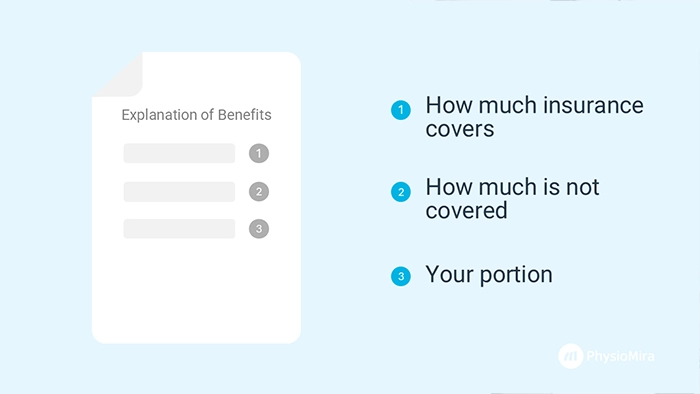
You can find all your EOBs in your PhysioMira Patient Account under the Documents tab.
If you have a secondary plan, you may need to submit this EOB to complete your second claim.
What Is a Deductible or Co-Pay?
A co-pay or deductible is a portion of a claim that your insurance does not cover.
Example:
If you have a $20 co-pay, you’ll always pay $20 per visit, regardless of how much your plan covers.
Think of it as your share of the cost.
Final Thoughts
Understanding private insurance in Ontario won’t feel overwhelming once you learn some of the terminology and understand some of the concepts and the details of your insurance policy.
If you made it this far down the page, you now have a better idea how insurance for physiotherapy works, what questions to ask your benefits provider before you come for your first visit, and what to expect after we submit a claim when you arrive.
Here’s the TL;DR:
- Direct billing simplifies everything for you
- Clinics cannot access your policy details
- Calling your insurer before your first visit is essential
- Deductibles, co-pays, and partial coverage are common
- Secondary plans require self-submission
Once you know your coverage, physio appointments become smooth, predictable, and stress-free.